Peptide Purity Guide 98%, 99% & Research-grade Explained Prg
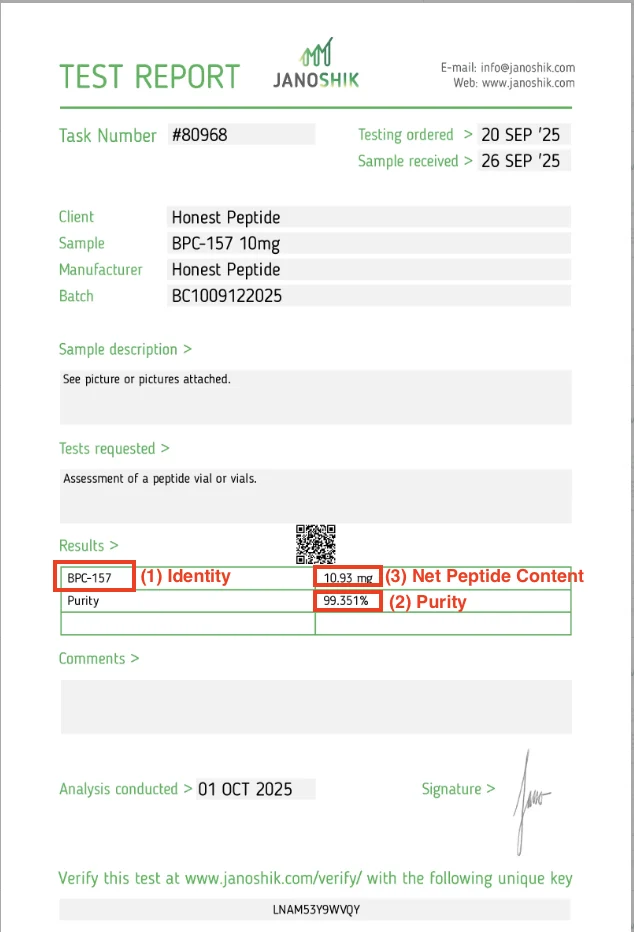

Trusted peptide distributors constantly mark their products in this manner and give high quality reports with HPLC and MS data to support the purity level. As long as you obtain peptides from a trusted source that provides a total certification of evaluation, you can be positive in the peptide's purity grade and usage scope. Peptides are checked with a combination of strategies, including HPLC for pureness, mass spectrometry (MS) for series verification, and nuclear magnetic resonance (NMR) for structural evaluation. These approaches help determine the peptide's composition, validate the molecular weight, and detect any type of structural modifications or contaminations, guaranteeing the peptide fulfills top quality and specification needs. With our comprehensive peptide analysis platform, Imaginative Proteomics has actually established a highly sensitive and specific system.
An accredited laboratory complies with stringent guidelines for test accuracy and technique recognition. You can often check if a laboratory is certified using its internet site or paperwork; accreditation guarantees the laboratory's procedures and outcomes are held to global standards. With high levels of experience in carb chemistry and our comprehensive peptide analysis platform, Creative Peptides can supply top quality peptide purity decision solutions. According to strict evaluation quality control and biosynthetic quality assurance standards, each peptide is purely monitored during the analysis cycle.
Services
HPLC can support claims regarding chromatographic pureness, impurity optimal concern, and destruction trends when the approach is appropriate and the chromatogram is available. If a peptide is re-tested after storage stress and anxiety, HPLC can reveal whether brand-new contamination optimals have actually shown up or whether the main peak location has decreased. This links straight with dealing with subjects such as peptide storage and peptide reconstitution. As an examples of product-level context, compare the anticipated masses for Retatrutide, BPC-157, and Semaglutide.- Peptide screening documentation should be interpreted as batch-level analytical proof for study product, not as clinical-use permission.Discover our catalog to view validated study substances and learn more regarding our testing and quality assurance process.For example, in order to make sure success in different peptide experiments, it may be necessary to eliminate trifluoroacetic acid (TFA), or to examine the solubility of hydrophobic peptides prior to doing the called for experiments.Notably, this pureness figure is commonly identified after purification (e.g. by HPLC) and focuses on peptide contaminations-- it doesn't count residual water, salts, or counter-ions in the dried peptide powder.A peptide noted at 75% pureness and one at 99% purity aren't just different grades-- they can create meaningfully various outcomes in the exact same assay.
A strong test report can sustain pureness, identity, and set traceability. It does not transform a study substance into a clinical product, and it does not replace experimental validation in the researcher's very own system. Peptide pureness isn't simply a number on a tag-- it's a window right into the quality of the artificial process and a forecaster of how trusted your study outcomes will certainly be. At Values Analytics, we offer specialized peptide testing and quantitation services to support research, pharmaceutical, and nutraceutical applications. Our research laboratory makes use of advanced instrumentation and validated techniques to make certain precise, reproducible data across even one of the most complicated peptide matrices. William is a study expert at Peptides Laboratory UK, specialising in research peptides, research laboratory compounds, and sourcing requirements for high-purity peptide products.
What Is Hplc? The Basic Concept
The purity of peptides is typically checked making use of high-performance fluid chromatography (HPLC). HPLC separates peptides based upon their communications with a fixed stage, permitting contaminations and byproducts to be recognized and evaluated. Additionally, mass spectrometry (MS) can be used to verify the peptide's molecular weight and series, supplying more confirmation of pureness by finding pollutants and destruction products. If you have actually ever obtained a synthetic peptide for a lab experiment, you've most likely saw a pureness percent on the certification of evaluation-- usually values like 95%, 98%, or perhaps 99%. Peptide pureness is an important high quality metric that informs you what portion of a peptide sample is the designated item versus unwanted byproducts.
Residuals Screening
Along with RP HPLC, our gifted scientists can additionally supply information on the molecular weight of peptides identified by mass spectrometry. Matrix-assisted laser desorption ionization time-of-flight mass spectrometry (MALDI-TOF MS) and electrospray ionization mass spectrometry (ESI MS) are both most generally used approaches. This post is attended to academic and study reference objectives just. All peptides sold by Peak Laboratory are intended exclusively for in-vitro research laboratory research study use and are not for human usage. Peptide screening documents must be taken batch-level logical evidence for research product, not as clinical-use permission. Peak's Just how to Check out a Peptide COA guide goes through this process detailed.
A single common chromatographic method is frequently inadequate for peptides that are hydrophobic, highly basic, very closely associated in turn, or partially purified. We supply Peptide Capsules HPLC and UPLC purity evaluation process that focus on useful splitting up instead of only generating a percent. We develop logical workflows around the sample kind, sequence attributes, alteration profile, and decision context. Jobs might include unrefined intermediates, detoxified peptides, saved great deals, client-supplied products, or materials produced through our custom peptide synthesis platform.